
March! A Brief History of How and Why We Do This
By JoAnn Kennedy Flanagan
About JoAnn: In 2016 JoAnn Kennedy Flanagan began writing and working on gerrymandering and campaign finance reforms in Virginia. She moved to Pittsburgh, PA in 2024 where she has continued to advocate for modernization and fairness in city, county, and state governance. JoAnn is a new member of the MarchOnHarrisburg communications team!
Left, right, left, right, left right. Those are the words that drill sergeants use to move armies. But there’s actually no left or right about the basic act of marching. One leg may be going forward, but in smooth, effective marching, the opposite arm is always synchronized with it. For marches aiming to change society and government, the traditional right and left political spectrum isn’t always useful. The most effective marches have emphasized using non-violent tactics, placing bold demands on people in power, and uniting everyday people around our shared human rights. As we march on Harrisburg, we are part of a long history of purpose-filled marching that has repeatedly turned the direction of our governments’ policies towards justice.
One of our most revered transcendentalists, Henry David Thoreau, thought the Mexican-American War was unjust, so he refused to pay taxes that could fund the War. As punishment for this resistance, Thoreau spent a night in the Concord, Massachusetts jail. This experience inspired his 1849 essay known as “Civil Disobedience” which urges people to disobey governmental laws that contradict their individual morals.
1930: The Salt March
“It also inspired generations of movement leaders.”
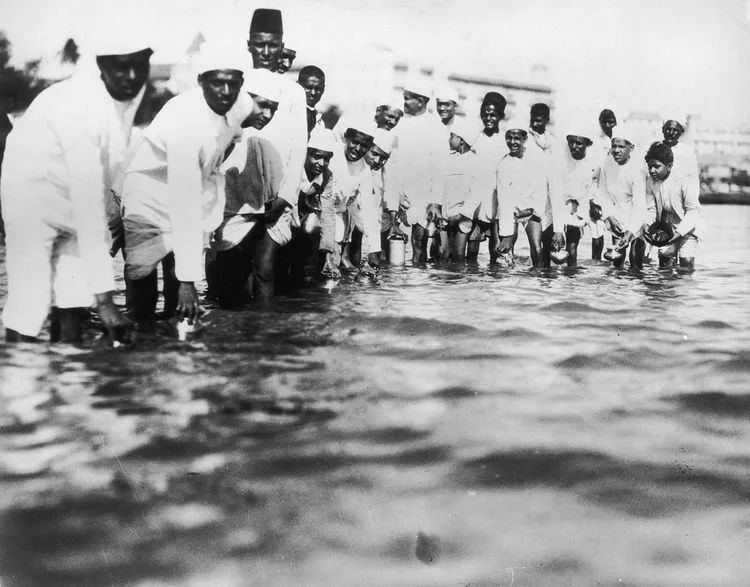
Photo of The Salt March.
About a half-century later, non-violent and anti-colonialist leader, Mahatma Gandhi, read “Civil Disobedience.” The essay helped Gandhi to effectively articulate his cause for western authorities and audiences. In 1930 Gandhi famously marched 240 miles over 24 days to the Indian seacoast. Along the way, thousands of everyday people joined Gandhi until the procession grew to a length of almost two miles. At the beach in Dandi, Gandhi evaporated sea water to produce salt. Gandhi chose to march to the sea to unite the classes, regions, and religions of India that were all impacted by a monopoly and high British taxes on salt. The Salt March showed the value of non-violent civil disobedience and was a memorable part of the long movement for Indian independence. Historic documents show that the Salt March left British officials in India confused and unsure of how to respond. The Salt March attracted world-wide attention to the injustice of British colonial rule in India. It also inspired generations of movement leaders.
1963: The March On Washington
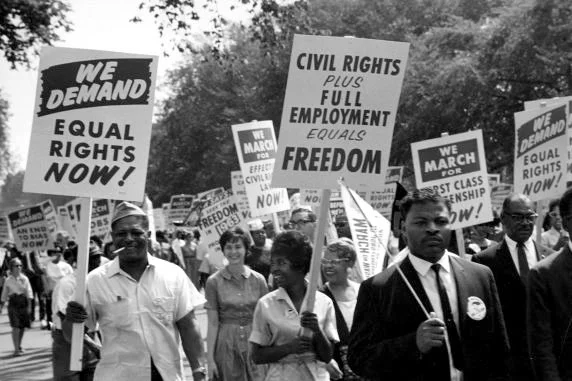
August 28, 1963. Historic March on Washington for Jobs and Freedom.
Martin Luther King Jr. and the American civil rights movement were directly influenced by Gandhi’s work. King wrote that Gandhi’s ways were “the only morally and practically sound method open to oppressed people in their struggle for freedom.”
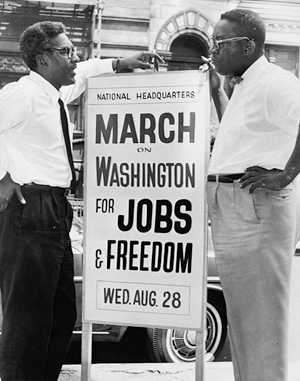
Bayard Rustin, deputy director, and Cleveland Robinson, chair of administrative committee.
At the Washington Monument on August 28, 1963, King delivered his famous “I Have a Dream Speech” to a quarter million peaceful marchers who attended the March on Washington for Jobs and Freedom. Like the Salt March, the March on Washington was part of a civil rights strategy that unfolded over decades. Many different civil rights organizations held smaller protests, sponsored court cases, and marched in other cities at other times to eventually result in an event attended by 250,000 Americans.
A goal of the March on Washington was to pressure Congress to pass civil rights legislation. On the day of the March, President Kennedy met with its leaders.
That evening Kennedy released a statement supporting the civil rights movement and praising the extensive organizing that made the March so effective and peaceful. After Kennedy’s death, President Johnson signed into law the Civil Rights Act of 1964 and the Voting Rights Act of 1965.
1960-1970s: Anti-War Protests
“This level of public engagement was impossible to ignore.”
During the 1960s and ‘70s there was a steady stream of protests, including marches, against the Vietnam War. These demonstrations were often on college campuses and organized by people of draft age, and like Civil Rights protests, they were often met with state violence. During a 1970 protest on the campus of Kent State University, the National Guard shot 13 students, killing four. This tragedy spurred more campus protests and increased the number of student walk-outs across the nation. There were also massive marches during this era, with hundreds of thousands of participants in New York, San Francisco, and Washington, DC. This level of public engagement was impossible to ignore. President Nixon’s CIA director, Richard Helms, noted that the 1971 Mayday protest was “one of the things that was putting increasing pressure on the [Nixon] administration to try and find some way to get out of the war.”
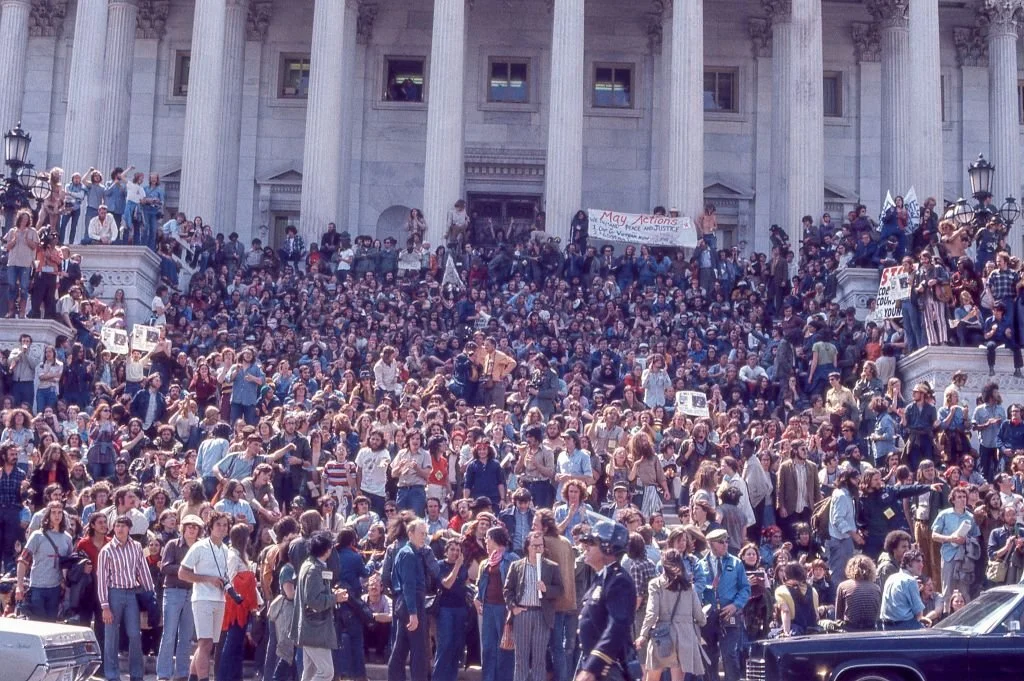
Antiwar protestors on the steps of the US Capitol on May Day, 1971.
“We now have the benefit of a long history of marches showing us that we must act intensely, nonviolently, and based on deeply held moral sensibilities. ”
Since the end of the Vietnam War, there have been protest marches and demonstrations against many military actions, and movements in PA and around the world continue to use marches and protests to move their causes forward. We now have the benefit of a long history of marches showing us that we must act intensely, nonviolently, and based on deeply held moral sensibilities. We continue the tradition of marching to improve our lives and make our governments responsive to We the People. We move beyond left-right binaries, we reject all divisions between Pennsylvanians, we march forward together to build a government that serves people, not profit.
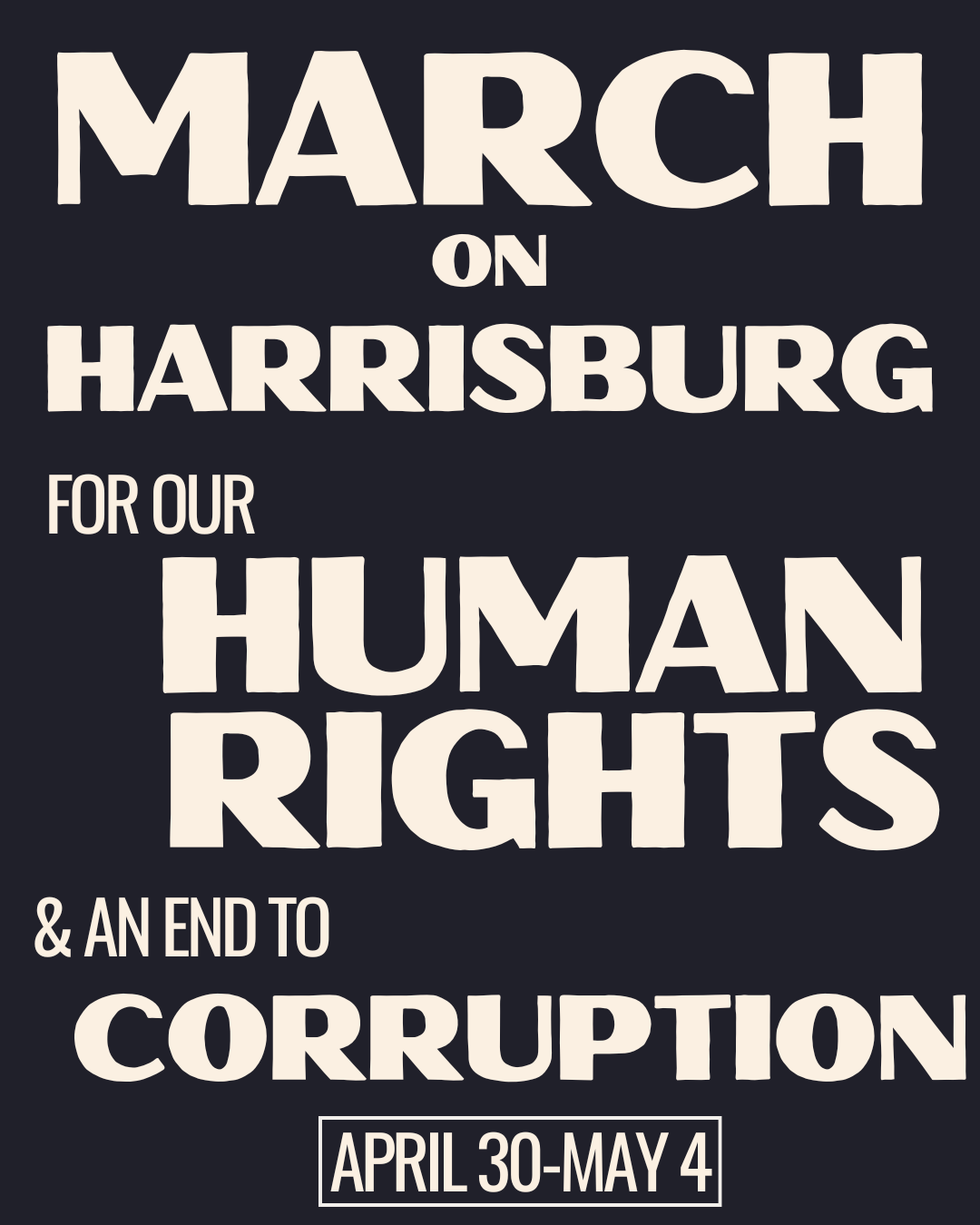
Poster for the upcoming March On Harrisburg.
It’s not too late! Sign up for the March On Harrisburg!
We are tired of corruption and corporate greed, and we’re taking power back into our own hands!
In one of the most corrupt states in the country, we are struggling to afford a decent life, while billionaires are getting richer than ever and bribing our politicians with lavish gifts, and cutting massive checks to their campaigns!
We are marching on to demand lawmakers stop billionaire bribes, and pass a Gift Ban! We are marching so we can have healthcare as a human right, a livable wage, affordable housing, a liveable environment, safety, dignity, hope, and so much more. We refuse to allow corruption to continue being a barrier to justice, and a barrier to getting the things we all need to survive and thrive!
Citations
https://nmaahc.si.edu/explore/stories/notes-march-washington
https://en.wikipedia.org/wiki/List_of_protests_against_the_Vietnam_War
https://www.whitehousehistory.org/anti-war-protests-of-the-1960s-70s
Photo Credits
Salt March: Hulton Archive / Archive Photos / Getty Images
Bayard Rustin and Cleveland Robinson: Library of Congress, photo by Orlando Fernandez for New York World-Telegram and the Sun Newspaper.
March on Washington: The Walter P. Reuther Library of Labor and Urban Affairs/the Labor History Archives at Wayne State University
May Day 1971: Stuart Lutz / Gado / Getty Images